

Humanitarian Aid, Emergency Programming & DRR: March 2026 Funding Opportunities (12 new opportunities!)
29 active signals: A $50M+ pool shifting from relief to 'Recovery Governance' -prioritizing the hospital management, school protection, and municipal frameworks needed to make stability stick.

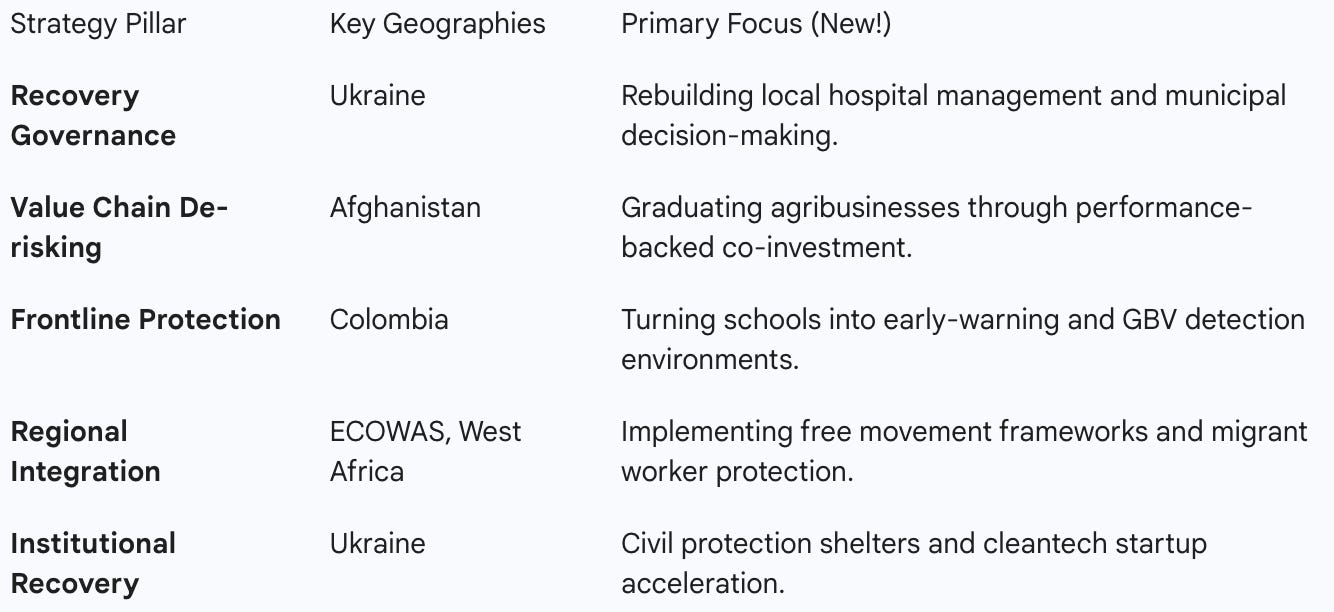
The March humanitarian funding landscape is moving decisively past short-term emergency response and into what we are calling the “recovery plumbing” of states under high pressure. We are seeing a heavy concentration of activity in Ukraine, with 10 new signals added this week alone, where funders like ADA and IREX are resourcing the hard infrastructure of civil protection and the professional management systems inside hospitals. The shift is clearly toward institutional maturity; it is no longer just about delivering relief, but about building the municipal frameworks and project management hubs that allow local authorities to lead their own recovery and attract future international financing.
In other high-stakes zones like Colombia and Afghanistan, the focus is on embedding protection and market resilience directly into existing community systems. UNICEF is currently resourcing schools to act as early-warning hubs for child protection, while FAO is using matching grants to graduate Afghan agribusinesses into formal, export-ready market players. For practitioners, the 2026 mandate is “Systemic Integration”—donors are increasingly selecting for partners who can prove their intervention will be institutionalized into school risk management plans or national agribusiness grids, ensuring the impact outlasts the grant period.
Snapshot of New Opportunities
Total Estimated Funding Pool: $50 Million+ USD
The grants are organized into three categories:
Open Calls: Current grant and opportunities with a deadline. Grants are listed by closing date. 13 open opportunities- 10 new!
Rolling Applications: current grant and opportunities with rolling applications (but it’s still best to submit as early as possible). 13 rolling opportunities- 2 new!
Long term planning: Grants that have closed their current rounds, but are expected to open new windows. 3 long term opportunities!
A quick tip for returning readers: if you want to jump straight to the newest additions, use CTRL F to search for “New!” and navigate quickly to the latest funding opportunities
This post is for paid subscribers. This helps support the time and effort it takes to curate and organize these opportunities.
To keep this accessible to everyone who needs it, we’re happy to pay what you can rates. You can find more details here.
Open Calls:
School as a Protective Environment for the Prevention and Response to Violence against Children and Adolescents (CEF/COL/2026/007), UNICEF. *New!* *Closing soon!*
UNICEF is seeking an implementing partner to strengthen schools as frontline protection systems in conflict-affected areas of Colombia where children face elevated risks of recruitment, gender-based violence, and attacks on education. The funder’s objective is to make schools function as protective environments that can prevent harm, detect risk early, and coordinate rapid response with protection authorities. The work combines four linked priorities: updating and validating school protection pathways and protocols; delivering community-based mental health and psychosocial support that reduces vulnerability and strengthens resilience; improving preparedness and response for sudden-onset emergencies by aligning school plans with municipal risk management systems; and reinforcing school signaling and early warning mechanisms so threats are surfaced quickly and acted on. Strong proposals will demonstrate local presence, technical depth in child protection in emergencies and GBV, and a practical approach to coordination, accountability to communities, and sustainability through institutional adoption in school risk management plans.
Geographies: Colombia (Arauca and Nariño; prioritized municipalities include Fortul and Tame, plus Tumaco and Barbacoas).
Who can apply: Civil society organizations with local presence and proven experience in child protection in emergencies, GBV prevention and response, and school-based MHPSS, able to coordinate with protection authorities.
Funding amount: Indicative budget 1,400,000,000 (currency not specified in listing).
Targeted Sectors / SDGs: Child Protection; Focus areas: safe schools, prevention and response pathways, GBV risk mitigation, school-based MHPSS, early warning and urgent alerts, emergency preparedness and response coordination.
Deadline: March 6, 2026.
This opportunity favors partners that treat protection as a school system function, with clear coordination protocols and measurable improvements in how risk is identified and acted on.
FAO Matching Grants in Afghanistan (EFSP) (Windows 1A, 1B, 2, 3), Food and Agriculture Organization of the United Nations (FAO). *New!* *Closing soon!*
FAO seeks to strengthen food security and agribusiness resilience in Afghanistan by co-investing in practical, growth-oriented upgrades across agricultural value chains. The program is structured as four windows that match enterprise maturity and market role, from entry-level support designed to increase women’s participation and overcome early investment barriers, through expansion capital for established producer groups and small agri-SMEs, to larger investments for provincial and national market operators, and a dedicated track for export-oriented businesses that can demonstrate export readiness. The funder’s logic is clear: prioritize investments that translate into stronger farmer linkages, improved aggregation and processing capacity, and more reliable market outlets, with measurable benefits for smallholder households. Because this is a matching scheme, FAO is effectively selecting for businesses that can mobilize real co-investment and show credible feasibility, governance, and implementation capacity aligned to their window.
Geographies: Afghanistan.
Who can apply: Agribusinesses and cooperatives in Afghanistan, including women-led start-ups, producer groups, SMEs, processors, aggregators, and export-oriented enterprises, based on window-specific criteria.
Funding amount: USD $5,000–15,000 (Window 1A); USD $15,001–30,000 (Window 1B); USD $30,000–60,000 (Window 2); USD $60,000–100,000 (Window 3).
Targeted Sectors / SDGs: Agriculture and Food Security; Focus areas: agribusiness expansion, value chains, market linkages, processing and value addition, export readiness, women-led enterprise growth.
Deadline: March 15, 2026 (11:59 PM Afghanistan time).
This call is designed to reward investable, farmer-linked business growth, so the strongest proposals make the co-investment and value-chain impact pathway unmistakably concrete.
2026 GCSP Prize for Transformative Futures in Peace and Security, Geneva Centre for Security Policy (GCSP). *Closing soon!*
The GCSP Prize for Transformative Futures in Peace and Security rewards innovative and forward-thinking concepts that offer bold approaches to advancing global peace and security. Open to individuals, teams, and organizations worldwide, this award seeks ideas with originality, implementation potential, and systemic impact. The winning concept will receive a fully funded two-month incubation at GCSP’s Creative Spark in Geneva — a unique opportunity to refine and amplify their approach within a global foresight and security innovation hub.
Geographies: Global.
Who can apply: Individuals, groups, and organizations (excluding current GCSP staff/fellows and families).
Funding amount: CHF 15,000 value (in-kind incubation program).
Targeted Sectors / SDGs: Peacebuilding; Focus areas: foresight, peace innovation, systems thinking.
Deadline: March 20, 2026 (23:59 UTC+1).
GCSP champions radical creativity grounded in systems analysis. Submissions should reflect both visionary thinking and grounded feasibility.
Strengthening Civil Society Organizations in Burundi, European Commission. *Closing soon!*
This EuropeAid call seeks to empower civil society organizations in Burundi to play a more active role in governance, democratic accountability, and human rights. With civic space in Burundi under pressure, the EU is prioritizing support for grassroots and national CSOs to amplify citizen voices, enhance legal advocacy, and strengthen institutional dialogue.
Geographies: Burundi.
Who can apply: NGOs legally registered in Burundi, EU Member States, or OECD countries; must be non-profit and not disqualified under EU PRAG.
Funding amount: EUR €1,000,000–1,500,000 per project; total call budget EUR €4,842,000.
Targeted Sectors / SDGs: Governance; Focus areas: civil society strengthening, democracy, human rights.
Deadline: March 24, 2026 (12:00 Brussels time).
The EU positions this as a long-horizon investment in civic voice and democratic resilience, amid one of Africa’s most fragile civic environments.
Support for Media that has moved from Occupied Territories, ZMINA Human Rights Center. *New!* *Closing soon!*
ZMINA seeks to protect access to credible information about occupied and de-occupied territories by stabilizing media outlets that were forced to relocate yet continue reporting under high operational strain. The funder’s objective is not only content production, but the full pipeline of public-interest journalism: sourcing, verification, and dissemination of information about human rights, freedom of expression, and conditions across social, economic, and environmental spheres in affected territories. The program explicitly encourages proposals with an innovation focus that strengthen audience reach, attract new readers, and improve delivery of information to audiences living under occupation, signaling a results logic that values both editorial relevance and distribution effectiveness. Funding is structured to support feasible, clearly targeted newsroom work plans, with accountability built in through staged disbursement tied to demonstrated delivery.
Geographies: Ukraine.
Who can apply: Nonprofit media organizations relocated from temporarily occupied territories to Ukraine government controlled areas that continue operating and can provide required registry and nonprofit documentation.
Funding amount: Up to USD $15,000.
Targeted Sectors / SDGs: Media and Information; Focus areas: verified reporting, occupied and de-occupied territory coverage, freedom of expression, audience reach, innovative formats.
Deadline: March 28, 2026 (23:59 Kyiv time).
This call is fundamentally about information resilience, backing media that can keep verification strong while widening reach to the audiences most cut off from reliable reporting.
