

Humanitarian Aid, Emergency Programming & DRR: February 2026 Funding Opportunities (10 new opportunities!)
34 calls: $40M+ for municipal recovery in Ukraine, multisectoral aid in Afghanistan & Lebanon, women-led protection in Syria, and AI disaster management in South Africa.

The February 2026 cycle for Humanitarian Aid and Disaster Risk Reduction (DRR) reflects a sector-wide pivot toward “Recovery Governance” and “Building Institutional Backbone”. We are observing a significant movement away from stand-alone relief toward Humanitarian–Development–Peace Nexus initiatives that prioritize the restoration of national systems in Ukraine, Lebanon, and Afghanistan. Funders like AICS and the Austrian Development Agency are shifting their focus toward civil protection infrastructure and the professionalization of the humanitarian workforce.
This month, the intelligence signal is defined by the Localization of Power, with major calls from ActionAid (Syria) and the Aurora Initiative explicitly resourcing women- and youth-led groups not just as implementers, but as strategic leaders. Simultaneously, the rise of AI-led Disaster Management in South Africa and “Jobs of the Future” training in Ukraine suggests that even in fragile settings, donors are looking to build the “recovery infrastructure” that aligns with long-term economic and technological transitions.
Snapshot of New Opportunities
To help you navigate this surge of data, here is a breakdown of where the funding is flowing and what the priority sectors look like for the first quarter of 2026.
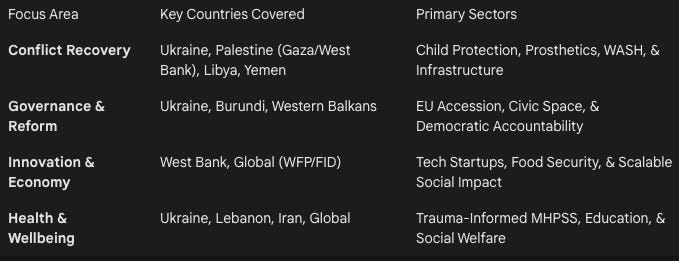
Total Estimated Funding Pool: $40 Million+ USD
The grants are organized into three categories:
Open Calls: Current grant and opportunities with a deadline. Grants are listed by closing date. 20 open opportunities- 7 new!
Rolling Applications: current grant and opportunities with rolling applications (but it’s still best to submit as early as possible). 12 rolling opportunities- 2 new!
Long term planning: Grants that have closed their current rounds, but are expected to open new windows. 2 long term opportunities- 1 new!!
A quick tip for returning readers: if you want to jump straight to the newest additions, use CTRL F to search for “New!” and navigate quickly to the latest funding opportunities
This post is for paid subscribers. This helps support the time and effort it takes to curate and organize these opportunities.
To keep this accessible to everyone who needs it, we’re happy to offer discounted rates / free membership for nonprofits and individuals from LMICs (Low- and Middle-Income Countries). Message us below for more information.
Open Calls:
Engaging Civil Society in Ukraine’s EU Accession Process, International Renaissance Foundation. *Closing soon!*
This IRF contest funds Ukrainian civil society organizations to generate expertise, advocate reforms, and facilitate inclusive dialogue tied to Ukraine’s EU accession pathway. The call focuses on strengthening capacities for policy analysis, monitoring compliance with the EU acquis, building consensus among stakeholders, and elevating public discourse on legal and institutional reforms. Priority activities include independent assessments of legislation and institutions, stakeholder dialogue facilitation, training on EU law, and communications that broaden societal support for integration. Successful proposals will show strong analytical frameworks, meaningful engagement strategies, and alignment with both national reform roadmaps and the broader “Whole Society Accession” initiative.
Geographies: Ukraine.
Who can apply: Civil society organizations, think tanks, unions, associations, and other registered non‑profit/charitable entities under Ukrainian law.
Funding amount: 500,000–1,800,000 UAH (optimal 1,000,000–1,400,000 UAH); total call budget 35,000,000 UAH.
Targeted Sectors / SDGs: Governance; Focus areas: EU integration policy analysis, advocacy, stakeholder dialogue, public awareness, legislative harmonization.
Deadline: February 3, 2026 (15:00 Kyiv time).
The call amplifies the role of civil society in shaping Ukraine’s EU accession narrative — from policy alignment and public discourse to inclusive stakeholder engagement.
Multisectoral Emergency Response to the Protracted Humanitarian Crisis in Afghanistan, Agenzia Italiana per la Cooperazione allo Sviluppo (AICS). *Closing soon!*
Through this call, AICS seeks to reinforce Italy’s humanitarian engagement in Afghanistan by funding integrated emergency responses that address both immediate survival needs and the erosion of community resilience in a protracted crisis setting. The initiative is framed around alignment with the Afghanistan Humanitarian Needs and Response Plan 2026 and emphasizes principled, needs-based humanitarian action delivered through coordinated, multisectoral approaches. AICS prioritizes interventions that combine life-saving assistance with protection outcomes for populations facing compounded vulnerabilities, including women, children, displaced persons, and people with disabilities. The funder’s strategy reflects a systems-oriented logic, encouraging strong coordination with UN-led clusters, complementarities with other donor-funded initiatives, and meaningful engagement with local actors. Accountability, localization, and adherence to humanitarian standards are positioned as core conditions for achieving impact in a highly constrained operational environment.
Geographies: Afghanistan.
Who can apply: Eligible non-profit civil society organizations under AICS regulations.
Funding amount: Total initiative budget of EUR €7,000,000.
Targeted Sectors / SDGs: Humanitarian Assistance; Focus areas: multisectoral emergency response, life-saving services, protection of vulnerable groups.
Deadline: February 8, 2026 (11:00 PM).
This call exemplifies AICS’s approach to protracted crises: pairing urgent humanitarian relief with coordinated, standards-driven action that reinforces dignity, protection, and resilience.
Syria–Türkiye Earthquake Emergency Response 2025, ActionAid. *New!* *Closing soon!*
Through this call, ActionAid Arab Region seeks to advance a locally led transition from emergency response to early recovery for communities in Syria affected by the 2023 earthquake, protracted conflict, and evolving return dynamics. The funding is explicitly framed around shifting power to women- and youth-led local organizations, positioning them not only as implementers but as leaders shaping protection, recovery, and resilience strategies in volatile contexts. Priority is given to interventions that integrate protection, livelihoods, community cohesion, and advocacy, while responding to the specific risks faced by returnees, internally displaced people, and host communities. By combining humanitarian action with early recovery and policy influence, the call reflects ActionAid’s commitment to localization, gender justice, and youth leadership as central drivers of sustainable recovery in crisis-affected settings.
Geographies: Syria.
Who can apply: Syrian local and national civil society organizations, with priority to women- and youth-led groups.
Funding amount: Grant size equivalent to GBP £100,000 per grant.
Targeted Sectors / SDGs: Humanitarian Response; Focus areas: women-led protection, youth-led recovery, community resilience.
Deadline: February 8, 2026 (23:59 Jordan/Syria Time).
This CFP reinforces ActionAid’s strategic intent to anchor earthquake recovery in locally governed, gender-responsive systems that link immediate protection needs with longer-term resilience and influence.
2025 Call for Partners — Western Balkans, PeaceNexus Foundation. *Closing soon!*
PeaceNexus is inviting civil society actors in the Western Balkans to apply for a tailored support partnership focused on strengthening their internal capacity to increase impact. This call is specifically for organizations working on reconciliation, trust-building across ethnic lines, or broader social cohesion through areas like youth, environment, or culture. PeaceNexus offers both conflict sensitivity and organizational development tracks, matching each partner with in-depth accompaniment and process funding. Rather than funding projects, this initiative invests in internal strengthening to help partners navigate shrinking civic space and complex political contexts with resilience, clarity, and confidence.
Geographies: Albania, Bosnia & Herzegovina, Croatia, Kosovo, Montenegro, North Macedonia, Serbia.
Who can apply: Civil society organizations, networks, foundations, multilateral bodies working in the region.
Funding amount: CHF 15,000–40,000 per year (up to 20% for overheads).
Targeted Sectors / SDGs: Civil Society Strengthening; Focus areas: conflict sensitivity, reconciliation, interethnic cooperation.
Deadline: February 8, 2026.
This is not project funding — it’s an investment in your ability to lead change, build resilience, and navigate polarized contexts.
Technology Acquisition and Deployment Fund (TADF): Innovative Technologies for Disaster Management in South Africa, Technology Innovation Agency (TIA). *New!* *Closing soon!*
TIA is inviting proposals for market-ready and advanced-pilot technologies that can strengthen South Africa’s disaster management system across the full disaster cycle; from risk assessment and early warning to response, recovery, and long-term resilience. The call is framed as a shift from reactive crisis response toward proactive, innovation-led disaster governance, with a strong emphasis on technologies that integrate science and technology with social and behavioral insights. Priority areas include AI-driven early warning systems, satellite and drone applications, inclusive preparedness tools, rapid response technologies, recovery and beneficiary-linkage platforms, and resilience-building solutions such as smart infrastructure and climate-resilient water systems. Proposals are expected to demonstrate feasibility, scalability, and alignment with national disaster management policies, while centering community engagement, equity, and local ownership.
Geographies: South Africa.
Who can apply: South African SMMEs, start-ups, non-profits, research institutions, and community-based organizations.
Funding amount: Up to ZAR R1,000,000 per project.
Targeted Sectors / SDGs: Disaster Risk Reduction; Focus areas: early warning systems, disaster response technologies, community engagement tools.
Deadline: February 9, 2026 (17:00 SAST).
This is a systems call, not a gadget call, framing your solution within national disaster governance and resilience priorities will strengthen alignment
