

Cross-Cutting / Intersectional Impact: February 2026 Funding Opportunities (19 new opportunities!)
68 calls: $250M+ for rural development in India, urban liveability globally, green/digital transitions in Uruguay, and community-led human security across 10+ countries."

The February 2026 cycle for Intersectional Impact marks a significant move toward “Hyper-Local Depth” and Integrated Transitioning. We are seeing a trend where major donors—from the SBI Foundation in India to the EU in Uruguay—are moving away from broad, shallow geographic spread in favor of concentrating resources within specific villages or “territorial communities.” The goal is to deliver visible, system-level improvements by layering education, health, and climate resilience interventions within a single, tightly defined space.
This month, the data highlights a powerful momentum behind “Liveability” and Financial Autonomy. Through high-stakes challenges like Temasek’s Liveability Challenge and the Vladimir Potanin Foundation’s focus on endowments, the focus is shifting toward solving the “double-transition” of urban greening and long-term financial independence for the non-profit sector. This month’s landscape reflects a shift toward “Place-Based Success,” where success is measured by how deeply an intervention takes root in a community’s legal and physical infrastructure.
Snapshot of New Opportunities
This section tracks funding that bridges multiple sectors to drive deep-rooted community transformation.
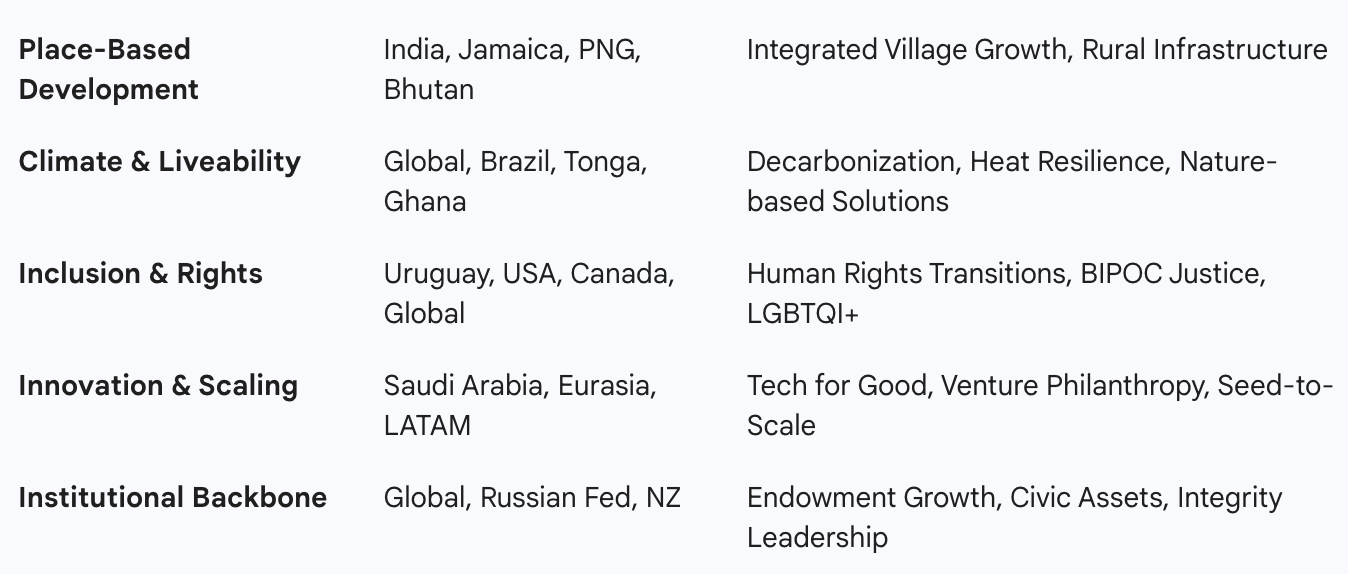
Total Estimated Funding Pool: $250 Million+ USD
The grants are organized into three categories:
Open Calls: Current grant and opportunities with a deadline. Grants are listed by closing date. 32 open opportunities- 16 new opportunities added!
Rolling Applications: current grant and opportunities with rolling applications (but it’s still best to submit as early as possible). 32 rolling opportunities- 2 new!
Long term planning: Grants that have closed their current rounds, but are expected to open new windows. 5 long term opportunities- 1 new!
A quick tip for returning readers: if you want to jump straight to the newest additions, use CTRL F to search for “New!” and navigate quickly to the latest funding opportunities
This post is for paid subscribers. This helps support the time and effort it takes to curate and organize these opportunities.
To keep this accessible to everyone who needs it, we’re happy to offer discounted rates / free membership for nonprofits and individuals from LMICs (Low- and Middle-Income Countries). Message us below for more information.
Open Calls:
AFJ Discretionary Grant Program 2026, American Friends of Jamaica (AFJ). *Closing soon!*
The American Friends of Jamaica (AFJ) is now accepting applications to support impactful, community‑focused initiatives across Jamaica. This grant targets Jamaican nonprofit organizations, schools, and universities that are legally registered and operating under the Charities Act, or submitting through the appropriate institutional offices. The AFJ Grants Committee awards discretionary grants to projects in four key development areas: Education, Healthcare, Economic Development, and Youth Nutrition. The program prioritizes measurable social impact and aligns funding with efforts that strengthen learning outcomes, improve health services, boost economic opportunity, and enhance youth food security. Successful organizations are required to submit narrative and financial reports every six months, reflecting AFJ’s commitment to accountability and sustained impact.
Geographies: Jamaica.
Who can apply: Registered Jamaican nonprofits, schools (via Principal/Superintendent), and universities (via Sponsored Projects/Foundation offices).
Funding amount: Up to USD 20,000 per grant.
Targeted Sectors / SDGs: Education; Focus areas: healthcare access, job readiness, economic inclusion, youth nutrition interventions.
Deadline: February 6, 2026.
AFJ prioritizes initiatives that strengthen core services and open up pathways to equity through local leadership.
SBI Sammaan – CSR Rural Development RFP (2026), SBI Foundation. *New!*
SBI Foundation’s SBI Sammaan initiative is a place-based CSR funding program designed to deliver integrated rural development outcomes in selected villages across India. Through this RFP, the Foundation seeks experienced nonprofit partners capable of implementing comprehensive, need-driven interventions that strengthen local infrastructure, essential services, and community resilience. The funder’s strategy emphasizes holistic village development, combining education, healthcare, water and sanitation, youth development, and basic infrastructure improvements within a single, tightly scoped geography. Selection logic prioritizes organizations with deep grassroots presence, demonstrated implementation capacity, and the ability to deliver measurable outcomes within a one-year timeframe. By limiting applicants to one village per proposal, SBI Foundation reinforces depth of impact and confirmable delivery over geographic spread, aligning CSR resources with clearly defined community needs and sustainability objectives.
Geographies: India (Himachal Pradesh, Maharashtra, Andhra Pradesh, Odisha).
Who can apply: Indian nonprofit organizations with at least 10 years of grassroots experience and operational presence in the project state.
Funding amount: Up to INR ₹1.00 Crore per project location (1-year duration).
Targeted Sectors / SDGs: Rural Development; Focus areas: integrated village development, education infrastructure, WaSH, youth and community facilities.
Deadline: February 6, 2026 (6:30 PM IST).
This RFP reflects SBI Foundation’s CSR strategy of concentrating resources in defined rural geographies to deliver visible, system-level improvements in quality of life.
Community Grants Program 2025–2026, Digicel PNG Foundation. *Closing soon!*
Digicel PNG Foundation is inviting community-based organizations across Papua New Guinea to apply for its 2025–2026 Community Grants Program. The initiative funds small to medium-sized projects that address pressing local challenges in education, health, peacebuilding, and sustainable livelihoods. Two funding tiers are available: Tier 1 (up to PGK 50,000) for first-time applicants and Tier 2 (up to PGK 100,000) for past grantees who have successfully completed and reported on earlier projects. All applications must align with the Foundation’s strategic outcomes and demonstrate local ownership, sustainability, and measurable community impact.
Geographies: Papua New Guinea.
Who can apply: Registered PNG-based non-profits with full statutory documentation; Tier 2 applicants must be past grantees.
Funding amount: PGK 50,000 (Tier 1); PGK 100,000 (Tier 2).
Targeted Sectors / SDGs: Education; Focus areas: peace through sport, financial inclusion, disability inclusion, maternal health, digital access.
Deadline: February 6, 2026.
The Foundation prioritizes locally grounded initiatives that align with its mission to build a connected, safe, and educated PNG.
Grant Assistance for Grassroots Human Security Projects (GGP) – Jordan 2026, Embassy of Japan in Jordan. *Closing soon!*
The Grant Assistance for Grassroots Human Security Projects (GGP) is part of Japan’s Official Development Assistance (ODA) framework, designed to support small-scale, community-focused initiatives that directly improve socio-economic conditions at the grassroots level in Jordan. Through this program, the Embassy of Japan seeks projects that deliver tangible benefits, from essential equipment procurement to community infrastructure renovations, supporting locally defined priorities and sustainable development outcomes. The funding logic emphasizes practical, operational impact and community ownership, prioritizing organizations with strong ties to their communities and demonstrated project delivery capacity. A comprehensive application, including financial audits, price quotations, feasibility planning, and legal registration proof, is required, with strict adherence to the submission deadline and format. By channeling ODA directly into grassroots interventions, the program enhances local capacities, fosters socio-economic stability, and complements broader development efforts in Jordan.
Geographies: Jordan (national).
Who can apply: NGOs, municipalities, educational institutions, or health institutions legally registered in Jordan with at least 2 years of operational experience.
Funding amount: JPY 10,000,000–20,000,000 per project (approx USD $65,000–130,000 / JOD 45,000–90,000).
Targeted Sectors / SDGs: Community Development; Focus areas: grassroots human security, socio-economic development, small-scale infrastructure.
Deadline: February 7, 2026.
The GGP reflects Japan’s model of targeted, community-led development assistance that strengthens local resilience while advancing human security outcomes in developing contexts.
Challenge for Change, Misk Foundation. *Closing soon!*
Misk Foundation’s Challenge for Change is a 7‑week hybrid acceleration and mentoring program designed to catalyze Saudi nonprofit and social ventures that address pressing social and environmental challenges. Across three thematic tracks, Technology, Health & Well‑Being, and Environment, participants receive tailored bootcamps, one‑on‑one mentorship, and expert guidance to refine their impact strategies and scale meaningful solutions. The program culminates in a competitive pitch phase where winning teams in each track can secure SAR 1M in grant funding to implement their project ideas. This experiential learning journey equips changemakers with the practical skills, networks, and resources to turn innovative concepts into sustainable community impact.
Geographies: Saudi Arabia.
Who can apply: Saudi nonprofit organizations and social ventures focused on social or environmental innovation.
Funding amount: SAR 1,000,000 per winning track.
Targeted Sectors / SDGs: Community Development; Focus areas: technology‑driven solutions, health & well‑being, environmental sustainability.
Deadline: February 9, 2026.
Designed to nurture the next generation of Saudi changemakers, Challenge for Change blends strategic mentorship with competitive grant awards to help community‑centered ventures translate bold ideas into measurable impact
