

Cross-Cutting / Intersectional Impact: April 2026 Funding Opportunities (30 new opportunities!)
91 active calls: $300M+. Startup ecosystems get the most new calls this month, while bilateral development mechanisms activate simultaneously across four continents, and funders invest in the leaders.

The April update for Cross-Cutting & Intersectional Impact is the broadest edition in this cycle — a catch-all section that this month tells a surprisingly coherent story about where flexible, systems-oriented funding is moving.
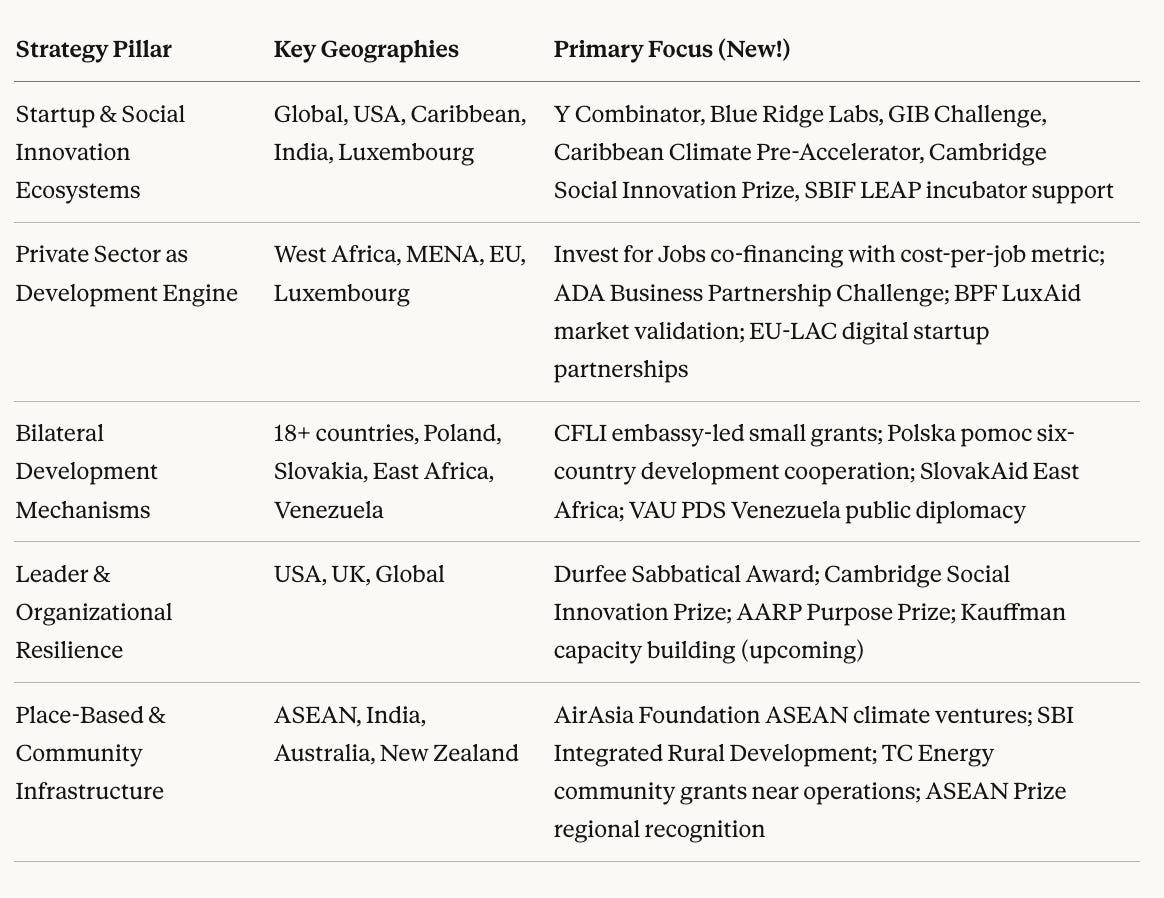
The largest single cluster of new calls is Startup and Social innovation ecosystems. Y Combinator’s Summer 2026 batch, Blue Ridge Labs’ Founder Fellowship, the GIB Startup Challenge, the Caribbean Climate Pre-Accelerator, Cambridge Social Innovation Prize, Startup World Cup Luxembourg, and SBI Foundation’s SBIF LEAP incubator support all land in the same month. These aren’t the same kind of call — they span idea-stage validation, mid-career leader acceleration, pre-seed venture investment, and incubator infrastructure. But taken together they signal that funders across geographies are simultaneously investing in the enabling layer of innovation: the founders, incubators, and programs that determine whether good ideas become organizations. The Cambridge Social Innovation Prize is worth particular attention as an outlier in this cluster, it explicitly funds mid-career social innovators who have already delivered results, treating leadership development as the intervention rather than the project. That framing is rare and reflects a growing recognition that individual leader constraints are often what caps organizational scale.
Private sector-led development is unusually active this month. ADA’s Business Partnership Challenge, the Luxembourg BPF, Invest for Jobs’ Investing for Employment call (up to EUR €10M per project), and the EU-LAC Digital Accelerator all use co-financing structures to leverage private enterprise toward jobs, market systems, and technology transfer in ODA-eligible countries. The Invest for Jobs call is the most specific: it measures success by cost-per-job, applies a ceiling on that metric at concept note stage, and in five of its six countries offers an optional labor migration-to-Germany pathway. That’s a development finance instrument being explicitly shaped by European workforce needs — a signal about where blended finance logic is heading.
Bilateral small grants mechanisms are also unusually clustered this month. Canada’s CFLI deploys simultaneously across 18 countries with embassy-led selection. Poland’s development cooperation call (28M PLN) activates across six countries. SlovakAid opens in East Africa. The Australia-Korea Foundation round focuses on emerging sectors and people-to-people ties. Mekong-ROK targets regional digital cooperation. These aren’t thematically unified — they reflect individual countries’ foreign policy calendars. But for practitioners working across multiple geographies, this is a month where embassy-level relationships translate directly into fundable opportunities, and the window for most of them is short.
Organizational and leadership resilience is a quieter signal but one that appears across several new entries. The Durfee Sabbatical Award funds LA County nonprofit executives to fully disconnect for three months while building organizational resilience in their absence. Kauffman’s upcoming capacity building round targets internal infrastructure that constrains delivery. The Cambridge Social Innovation Prize and AARP’s Purpose Prize both center the leader rather than the program. These calls collectively suggest a growing funder recognition that the people and systems behind organizations are fundable in their own right — not just the outputs they produce.
For practitioners in the startup and social innovation space, this month’s density means increased competition but also multiple entry points for the same venture — different funders, different stages, different geographies. The most efficient strategy is clarity on which stage you’re actually at and which funder’s selection logic matches. For organizations working across ODA-eligible geographies, the private sector co-financing calls (ADA, BPF, Invest for Jobs) reward partnerships with real commercial logic — proposals that lead with impact but can’t show commercial viability will struggle. For bilateral grant practitioners, speed is the primary competitive variable this month: embassy-led selection moves fast, often to known actors, and deadline clusters mean multiple mission deadlines fall within days of each other. For executive leaders of nonprofits, the Durfee call is genuinely unusual — it’s worth reading carefully if you’re running an LA County organization and have been considering what leadership succession actually requires.
Snapshot of New Opportunities
Total Estimated Funding Pool: $1.15 Billion+ USD
The grants are organized into three categories:
Open Calls: Current grant and opportunities with a deadline. Grants are listed by closing date. 43 open opportunities- 26 new opportunities added!
Rolling Applications: current grant and opportunities with rolling applications (but it’s still best to submit as early as possible). 40 rolling opportunities- 2 new!
Long term planning: Grants that have closed their current rounds, but are expected to open new windows. 8 long term opportunities- 2 new!
A quick tip for returning readers: if you want to jump straight to the newest additions, use CTRL F to search for “New!” and navigate quickly to the latest funding opportunities
This post is for paid subscribers. This helps support the time and effort it takes to curate and organize these opportunities.
To keep this accessible to everyone who needs it, we’re happy to offer pay what you can rates. You can find more details here.
Open Calls:
Canada Fund for Local Initiatives (CFLI) - Open calls, Global Affairs Canada. *New!* *Multiple opportunities closing soon*
Canada’s CFLI is a small-grants mechanism run through Canadian embassies and high commissions to fund locally led, implementation-ready projects that can demonstrate measurable results under Canada’s international assistance priorities. The fund’s logic is catalytic: it favors tightly scoped initiatives that translate a clear problem statement into a practical activity plan, credible local delivery capacity, and outcomes that can be communicated cleanly to mission decision-makers. While each country program sets its own thematic emphasis and grant-size norms, most calls prioritize combinations of inclusive governance, peace and security, gender equality, human dignity, growth that works for everyone, and environment and climate action, with selection typically made by an embassy-led committee. The most reliable workflow is: pick the mission page for your country, confirm thematic fit, and submit using the mission’s required template and channel (often email), by the mission’s time-zone deadline.
Geographies: ASEAN; Burundi; Cambodia; Dominican Republic; El Salvador; Equatorial Guinea; Guyana; Malaysia; Mauritania; Morocco; Myanmar; Panama; Republic of Moldova; Rwanda; São Tomé and Príncipe; Suriname; Thailand; Vietnam.
Who can apply: Local nonprofits/NGOs and academic institutions; eligible local government institutions or agencies implementing locally focused projects.
Funding amount: Grants range CAD $15,000-49,000.
Targeted Sectors / SDGs: Community Development; Focus areas: inclusive governance, peace and security, gender equality, human dignity, environment and climate action.
Deadline: Rwanda (April 6, 2026); Burundi (April 6, 2026); Vietnam (April 7, 2026); Thailand (April 8); El Salvador (April 10); São Tomé and Príncipe (April 12, 2026); Equatorial Guinea (April 12, 2026); Panama (April 12, 2026); Malaysia (April 13, 2026); Dominican Republic (April 13, 2026); Republic of Moldova (April 17, 2026); Myanmar (April 19, 2026); Cambodia (April 21, 2026); Guyana (April 30, 2026); Suriname (April 30, 2026); ASEAN (April 30, 2026), Mauritania (May 1, 2026), Morocco (May 1, 2025)
CFLI selection is “mission logic” funding: the strongest proposals read like a practical memo to the embassy committee, showing tight alignment to that mission’s priorities, realistic deliverables within the grant period, and clear, verifiable results.
Stephen Lloyd Awards 2026, Bates Wells Foundation. *New!* *Closing soon!*
The Foundation seeks to unlock early-stage, system-level solutions to social and environmental challenges by backing ideas that are novel, practical, and built for durable change. The Awards are designed as more than a cash prize: they combine funding with a structured pathway of expert engagement, using interviews, a finalist development phase, and a partner network to help applicants pressure-test feasibility, strengthen delivery plans, and build credibility. The funder’s priorities favor start-up and early-stage initiatives that can shift underlying drivers of harm, including through policy change, new models, or targeted campaigns, rather than incremental extensions inside large organizations. Projects may be delivered in the UK or abroad, but the applicant must be UK-based and able to demonstrate exclusively charitable purposes under England and Wales law.
Geographies: United Kingdom (applicant-based); projects may be in the UK or abroad.
Who can apply: UK-resident individuals and UK-established charities, nonprofits, and social enterprises with systemic social or environmental ideas.
Funding amount: £25,000 (winner award); up to ten awards of up to £2,500 (finalist development phase).
Targeted Sectors / SDGs: Social Inclusion & Equity; Focus areas: systemic change, early-stage social innovation, policy change, campaigning, environmental innovation.
Deadline: April 8, 2026 (23:59 UK Time).
This is a structured bet on execution readiness: the Awards use pro bono expertise and staged selection to convert promising ideas into implementable, trustee-approved charitable action.
Climate Impacts Awards: Unlocking urgent climate action by making the health effects of climate change visible (2026), Wellcome. *Closing soon!*
Wellcome seeks to accelerate near-term climate policy action by funding large, transdisciplinary projects that make the health impacts of climate change visible and politically actionable. The scheme is designed around an evidence-to-policy logic: teams must identify a specific, decision-relevant gap on climate-related physical or mental health outcomes, quantify or interpret associated economic implications, and pair this with a targeted influencing and engagement strategy aimed at a real policy opportunity within the award timeframe. Wellcome emphasizes engaged research, expecting meaningful involvement of decision-makers and communities affected by climate change throughout project design and delivery.
Geographies: Global (excluding mainland China).
Who can apply: Mid-career and established researchers leading transdisciplinary teams hosted by an eligible not-for-profit administering organization; coapplicants required.
Funding amount: Up to GBP £2.5 million per award, they expect to make 10-15 awards.
Targeted Sectors / SDGs: Health; Focus areas: climate change and health, policy influence, engaged research, economic impacts of health, evidence synthesis.
Deadline: April 8, 2026 (15:00 BST).
The strongest proposals will treat policy uptake as a core deliverable, with evidence, economics, and engagement tightly integrated around a specific decision window.
Polska pomoc rozwojowa 2026 (Open Call for Development Cooperation Projects), Ministry of Foreign Affairs of the Republic of Poland. *New!* *Closing soon!*
Poland’s Ministry of Foreign Affairs seeks implementable, results-driven development cooperation projects that advance country-specific priority outcomes across six partner countries, using a grant structure calibrated by national envelopes and clear results frameworks. The call is designed to fund proposals that translate policy priorities into measurable, within-year delivery, with an option for two-year modular programming where the second-year module builds on verified first-year results and remains budget-contingent. Across geographies, the funder emphasizes institutional and service delivery improvements that can be sustained through local partnership, with cross-cutting expectations on gender equality and climate considerations embedded in project design. With a high minimum grant threshold and formal compliance requirements, the program favors organizations that can demonstrate operational readiness, credible local collaboration, and a tight results chain from activities to verifiable outcomes.
Geographies: Ukraine, Moldova, Palestine (excluding Gaza), Lebanon, Kenya, Tanzania (territorial exclusions apply in several countries).
Who can apply: Polish NGOs and other eligible public benefit entities; public universities; research institutes; Polish Academy of Sciences units.
Funding amount: Minimum grant: 750,000 zł (per project or per module). Total pool: 28M PLN; Country envelopes: Ukraine 14M PLN, Moldova 4.3M PLN, Palestine 2M PLN, Lebanon 2M PLN, Kenya 3M PLN, Tanzania 3M PLN.
Targeted Sectors / SDGs: Economic Inclusion & Livelihoods; Focus areas: entrepreneurship and decent work, job creation, vocational education and training, crisis management capacity, health systems strengthening.
Deadline: April 9, 2026.
This competition rewards implementers that can treat country envelopes and result areas as a disciplined delivery contract, not a broad thematic menu.
Mekong-ROK Cooperation Fund (MKCF) 10th Call for Regional Project Proposals (EOI stage), Mekong–Republic of Korea Cooperation Fund (MKCF). *New!* *Closing soon!*
MKCF seeks to catalyze practical Mekong–ROK cooperation through regional projects that tackle shared development challenges with measurable results and a credible pathway to scale or replication. The fund’s investment logic prioritizes proposals that generate cross-border value, strengthen partnerships among Mekong institutions and ROK counterparts, and remain sustainable beyond the grant period. While implementation can be country-based, proposals must demonstrate clear benefits for the wider Mekong subregion and cooperation outcomes that extend beyond a single national context. Cross-sector and integrated approaches are encouraged where they increase regional value addition, and the call explicitly favors innovation, demonstrable impact, and designs that translate into longer-term regional integration and resilience.
Geographies: Cambodia, Lao PDR, Myanmar, Viet Nam, Thailand, Republic of Korea (regional relevance required).
Who can apply: Government agencies, NGOs, academic and training institutions, and international organizations (including UN agencies) from eligible countries.
Funding amount: USD $300,000–1,000,000 per project.
Targeted Sectors / SDGs: Innovation & Technology; Focus areas: ICT, digital transformation, AI, fintech, e-commerce, early warning systems.
Deadline: EOI: April 10, 2026.
This call rewards proposals that treat “regional relevance” as an outcome design choice, not a geographic label, by building cooperation pathways that can be taken up across borders after the grant ends.
Business Partnership Challenge 2026, Austrian Development Agency. *New!* *Closing soon!*
Austrian Development Agency seeks to accelerate sustainable business practices in ODA-recipient countries by co-financing commercially viable partnerships between Austria/EEA+ enterprises and local private-sector actors. The program’s investment logic is explicitly market-systems oriented: proposals are expected to diagnose context and market failures (including gender dimensions), define the applicant’s role in the system, and show how interventions will drive systemic change through inclusive access to services, training, technology, or information. ADA prioritizes projects that are multi-stakeholder, scalable, and grounded in “do no harm,” with credible monitoring frameworks and safeguards for environmental, social, and gender risks. Eligible projects must contribute to SDG 8 and SDG 9, embedding decent work and SME development as core outcomes, while demonstrating long-term commitment beyond the grant period.
Geographies: Global (all ODA-recipient countries).
Who can apply: Enterprises registered in Austria/EEA+ or Switzerland, with local registered partners in target countries and at least 3 years of existence.
Funding amount: EUR 500,000–1,000,000 per project (total pool EUR 5,000,000; ADA up to 50% co-financing).
Targeted Sectors / SDGs: Economic Inclusion & Livelihoods; Focus areas: inclusive market systems development, SME development, decent work, sustainable business practices.
Deadline: April 12, 2026 (11:59 PM CET).
This call rewards partnerships that can convert private investment into durable local market improvements, not isolated pilots.
AstraZeneca Young Health Programme Impact Fellowship 2026, One Young World. *Closing soon!*
AstraZeneca’s Young Health Programme, delivered through One Young World, seeks to scale youth-led solutions that improve health outcomes by investing in leaders who can turn community insight into measurable action. The fellowship is structured as a combined leadership platform and implementation catalyst: it funds a defined project window while embedding Fellows in a global convening and learning network intended to accelerate execution, visibility, and partnerships. The funder framing centers on earlier intervention and systems leverage, prioritizing work that advances health equity (including prevention of non-communicable diseases among young people), strengthens health systems resilience, or addresses the intersection of climate, nature, and youth health. Selection implicitly rewards organizations that are funding-ready and able to translate a clear theory of change into credible delivery and reporting.
Geographies: Global; Summit in Cape Town, South Africa.
Who can apply: Individuals aged 18-30 who lead a registered nonprofit organization (registered and operational for at least 3 full years).
Funding amount: USD $10,000 (Fellow grant); USD $50,000 (if selected as Lead2030 SDG 3 winner).
Targeted Sectors / SDGs: Health; Focus areas: health equity, NCD prevention, youth health, climate and health, health systems resilience, rare diseases.
Deadline: April 12, 2026.
This is designed to convert youth leadership into implementable, reportable outcomes, so feasibility and evidence of adoption pathways matter as much as ambition.
